
PFAS. You may already be liable and you don't know it yet.

PFAS (Per- and polyfluoroalkyl substances) are toxic man-made "forever chemicals" used to make products water, fire, oil and stain-proof. Somewhere in the industrial supply chain, in product formulation, in components that have been bought for years, there is a high probability that PFAS chemicals are used in ways companies have never been aware of. And in ten years, it could be the reason you're standing in front of a court.
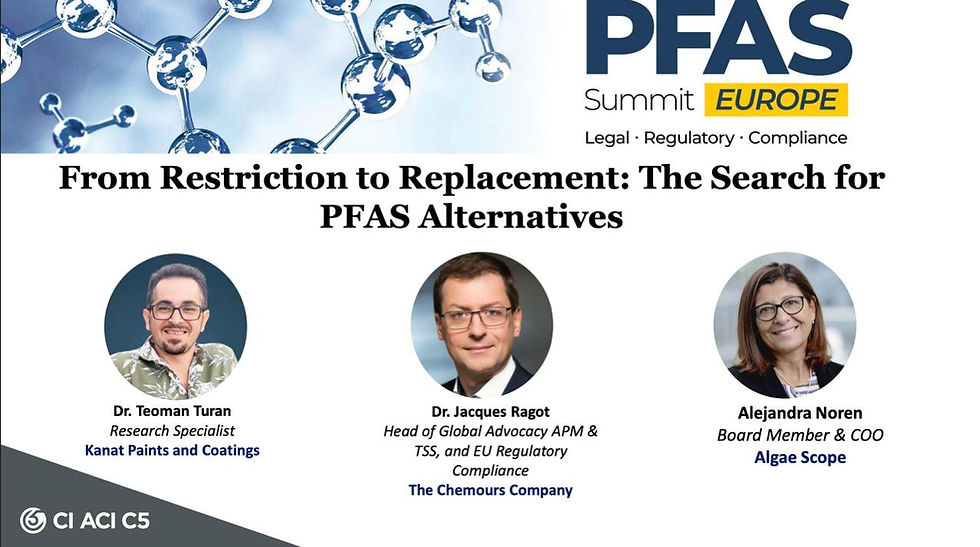
This was one of the big messages that started to emerge at the C5 PFAS Summit Europe on 19-20 May 2026 in Brussels.
The Litigation Wave Is Coming
Across Europe and North America, companies that manufactured, used, or distributed PFAS are facing lawsuits, regulatory penalties, and clean-up costs running into the hundreds of millions, and in some cases, billions.
How did this come about?
In recent decades, health impacts have emerged in surrounding communities or among workers of companies that sold or used products containing PFAS. These included thyroid disease, immune suppression, certain cancers, and infertility. Investigations began, and then came the question no board wants to face: when did you know, and what did you do about it?
The companies that fare worst are not always the biggest polluters. They are the ones who couldn't demonstrate they had taken the problem seriously. No internal review. No supplier audit. No documented effort to understand their exposure. In the eyes of regulators and juries, ignorance is not innocence.
The Regulations Are Already in Motion

Five European countries - Denmark, Germany, the Netherlands, Sweden and Norway - jointly submitted a sweeping proposal to restrict PFAS across the EU, calling for limits on the manufacture, use and market placement of the chemicals. This is the most extensive chemical restriction proposal in EU history, covering more than 10,000 substances.
And critically: the public consultation period on the final committee opinions closed on 25 May 2026. The window for industry to shape the outcome is closing. What comes next is implementation.
France has already moved independently, adopting legislation that bans PFAS in cosmetics, textiles and ski wax from 2026, extending to all textiles by 2030. Other member states are following. This is a coordinated shift across European regulation, not a single isolated rule with a single compliance date
"You Need to Get Ready"
To every company still waiting to see how this plays out, the caution is understandable. Changing materials, reformulating products, re-qualifying suppliers present real costs and challenges. Some industries, particularly electronics, semiconductors and aerospace, face difficult substitution problems where technically viable alternatives remain limited, and they have been pushing back hard. That pushback is understandable.
But the direction of travel is not in question. These changes are coming, and the only variable is whether your company is prepared when they arrive or scrambling to catch up.
Transition periods of between five and twelve years are being discussed for sectors where alternatives are not yet available. But transition periods are not exemptions. They are countdowns. And the companies using that time to actively develop alternatives and document their efforts will be in a fundamentally different legal and commercial position to those who treat them as a reason to delay.
The Regulations Require Action Plans
This is the part many companies are not yet aware of, and it matters enormously. The emerging PFAS regulatory framework does not simply ban substances and leave companies to figure it out. It requires documented action. Companies in affected sectors are expected to demonstrate what they are doing, when they plan to do it, and what milestones they are working towards.
What a credible action plan looks like in practice:
A PFAS inventory across your products and supply chain, identifying where and in what quantities PFAS are present;
A prioritised substitution roadmap, with timelines tied to regulatory deadlines;
Documented supplier engagement, showing that you have asked the right questions and recorded the answers;
Board-level sign-off, demonstrating that this is treated as a strategic risk, not a procurement footnote.
Companies that can produce this documentation are in a defensible position. Companies that cannot are exposed to regulators, to insurers, to litigants, and increasingly to their own customers and investors who are beginning to ask these questions.

The Cost of Doing Nothing
The cost of inaction is not a fixed penalty, but a number that grows every month you delay, across multiple dimensions simultaneously.

Regulatory fines under REACH for non-compliance are significant and escalating as enforcement capacity across member states increases.
Environmental clean-up liability, where PFAS contamination is traced to a company's operations or products, can dwarf any fine. The remediation of contaminated water and soil runs to tens of millions per site, and courts are increasingly assigning that cost to the source. Health impact claims accumulate over time - as more individuals come forward and the scientific record strengthens, the legal exposure for companies only deepens. Insurance exposure is tightening, with underwriters beginning to exclude or heavily price PFAS-related liability from standard policies, meaning that companies that have not acted may find themselves uninsured at a time when they need coverage most. And credit and investment risk is moving in the same direction, with ESG frameworks and lender due diligence increasingly flagging PFAS exposure as a material risk that affects cost of capital.
Every delay adds to each of these simultaneously. A company that begins its PFAS action plan today faces a manageable challenge. A company that begins in three years, under regulatory pressure, faces a potential crisis.
Algae Scope's perspective

Algae Scope's Chief Operating Officer, Alejandra Noren, attended the C5 PFAS Summit in Belgium in May 2026, and what struck her most was not the scale of the problem, but the quality of the engagement happening around it.
Industries are showing up. Electronics, textiles, healthcare, packaging - sectors that have every reason to resist are instead sending their technical and legal experts to sit in the same room as regulators, scientists and alternative material developers. That is not the behaviour of industries planning to ignore this. That is the behaviour of industries that know change is coming and are trying to shape it intelligently.
That shift matters, because the path from "PFAS are everywhere" to "PFAS are being replaced" does not run through regulation alone. It runs precisely through these conversations - where a manufacturer understands for the first time what a bio-based alternative can and cannot do; where a regulator hears directly from an engineer why a five-year transition is realistic but an eighteen-month one is not; where a company like Algae Scope can present its technology, not as a theoretical possibility but as a practical option being tested against real applications.
The multi-stakeholder dialogue that is forming around PFAS substitution is one of the most constructive industrial conversations happening in Europe right now. It is producing a forward-looking roadmap - a grounded, sector-by-sector plan for how safer materials enter supply chains, how value chains become more resilient, and how industry stays competitive through the transition rather than being blindsided by it.
Our technology is being explored as a safer alternative in selected applications where PFAS have historically been considered essential. We do not present these alternatives with the claim that we have solved everything, but with the evidence that viable substitution is possible, and that the companies willing to work through the technical and commercial questions now will be the ones best positioned when the regulatory deadlines arrive.
If you are a company navigating PFAS exposure in your products or supply chain, we want to work with you - to understand your specific applications, and explore together whether a substitution pathway exists and what it would take to get there.
What do we think it will take to get there? Industry engaging seriously, alternatives being tested honestly, and solutions being built collaboratively.
Comments